Monday, 9 January 2017

Directions Unit - Screen Language in Taxi Driver


Today I learnt a lot about the art of screen language when watching a film. Looking at Taxi Driver we analyised the integration of visuals and sound that Martin Scorsese developed as a director of the film and how it helped to add multiple layers to aplify the story.

Characters are key to storytelling and with the help of screen language we get more of a sense of their personalities and who they are as people. With Travis he is shown to change as the film progresses. It starts of with him being a very standard and average guy who is looking for a job as a taxi driver. As the film goes on we see him striping down to a half naked self and gaining muscle creating a more tough like approch. Towards the end of the film he has changed completely, particularly noticing the hair cut as a mohark. It shows the madness in his change into something more frightning and scary. Through his behaviour and these language codes the audience is aligned with the character but in a very anti-hero light. We like the character but we dont agree with a lot of the things he's done.

Stage one: Average Guy 

Stage Two: Toughening Up

Stage Three: Mad Man

When Betsy first comes on the screen she looks striking. She wearing nice clothes, has perfect hair and is very together. she wear white which shows her angelic side and gives the audience a sense of innocence. As she goes on a date with Travis she wears red and the dress has a low plunge. This shows her more sultry and lustrous side. 


With Iris we see a dolled up 13 year old who is selling herself on the streets. We can tell this by what she wears with the short denim shorts and the other revealing clothes. As we see Travis taking her to breakfast we see a very different girl. She wears bright plastic glasses and bright clothes looking more child like and innocent. 


Friday, 6 January 2017

Directions Unit - Sam Mendes Research: Revolutionary Road Review (2008)


Revolutionary Road, a film set in the 1950's focusing on the lives of Frank and April Wheeler who struggle with the realities of living what appears to be the American dream. With Frank tired of his relentless job, April bored of her run of the mill house wife duties, the couple decided to act upon a life long dream of moving to Paris in a hope for a happier and exciting new life. Forced to reconsider when Frank is offered a promotion and April falls pregnant, they struggle to come to terms with the fact things might not be as simple. Sam Mendes directs this Melodramatic adaptation from the same titled novel exploring themes of infidelity, marriage and conformity proving the instability and conflict that still exists in what is classed as the utopian life.


The first thing to notice is the story telling as a whole. It is strong and realistic moving at a steady pace through the whole film. When watching you can't deny the alignment you have between the two characters wanting them to succeed and escape their mundane routines, but as life gets in the way, reality and complications set to fade their dreams further from them than what was first imagined. In a quote from an interview, Sam says: "Paris is a metaphor. We all have our Paris, our escape, our Eden"and this is truly what the film is about, escapism. On this roller coaster journey with the Wheelers you begin to emulate the emotions that they are feeling too as Mendes has demonstrated really well throughout.


In terms of the way the film is shot, Mendes has chosen to show a very cinematic way of filming with beautifully lit scenes of simplicity and static camera angles creating a hyper-sense feel to what we as a viewer are witnessing. "I felt like it needed a much more honest, direct and simple approach". Its real but its bold and almost surreal creating a point of two unhappy characters fighting something inside a perfect and beautiful setting they can't find themselves in. The audience is shown elegance and class but at the heart of it all is turmoil and emptiness.


The score is hauntingly beautiful, composed by Thomas Newman, it adds sympathy as well as class and elegance to the film. Sam commonly works with Newman on most of his features to encorporate drama with emotion in adition to what as an audience are meant to be feeling as we are watching things unravel on screen. The music builds up almost like April and Franks excitement for a better life but then it softly drops to slow and sombre as if its realised the dream is diminishing.


Mendes has casted the films main characters as Leonardo DiCaprio and Kate Winslet. He has done this for many reasons. They are both recognisable and very well received actors and with a film that touches on very complex levels, the thought of having two very reputable actors to play the parts was something key to making the film work. Kate was also Sam's wife at the time as he said this made working with her very easy. Through their previous work, they have both acted in dramas before and more notably, together. In the Titanic they both play the protagonists Jack and Rose. Credited highly for the roles they played, Sam could have seen the on screen chemistry between them and wanted to reignite it for Revolutionary Road.

When choosing a location to shoot the film, Sam chose Darien in Connecticut. He did this to make the film seem more realistic than a studio. It was filmed in a proper house and he said with all the crew and the temperature of the weather it added to the actors performances. "We wanted to get a sense of reality, and for the pressure cooker of the Wheelers' house to feel real. It was very hot. It was a small house, with all the crew jammed in there. But I think that reality fed the performances".


http://www.londonnet.co.uk/cinema/interviews/revolutionary-road-sam-mendes


Wednesday, 7 December 2016

Contextual Studies - Critical Review for a TV Show - American Horror Story: Roanoke


"One of television's great contributions is that it brought murder back into the home, where it belongs". - Alfred Hitchcock, National Observer, 15th August 1966

In this Critical review, I will be looking at the latest miniseries installment to the popular TV show American Horror Story. Based loosely on the missing colony of Roanoke Island in 1590, the show creator Ryan Murphy explores his tale of uncovering the mystery through horror and exaggerated themes in unusual ways that keep the show fresh and popular.


The clear genre of the show is Horror as suggested by the title but it's clear by the codes and conventions used throughout the series. The use of violence is used heavily with the use of props including knives, chainsaws and impalement on sharp objects like spikes. Gore is used in many types of horror to implement the realism of the terrifying situation but also to create shock and excitement which Ryan has clearly tried to exceed. The show also contains many monsters and supernatural happenings to the protagonists to create fear and cover the sub-genres of slasher as well as supernatural in Horror. He has done this to appeal to a wider audience playing on at least one fear of a viewer. The location is set in an abandoned house which looks a bit like Norman Bates house. It is a purpose built set for the program in an isolated location. This allows the audience to relate to the fact the characters are on their own with limited help often used in many other horrors like The Texas Chainsaw Massacre and Friday the 13th. We as an audience can tell it's a set due to the hyper-realism that Murphy portrays in a cinematic viewing approach. Everything Murphy does is exaggerated on a grand scale and this is reflected in this series with close relations to The Shining. 


Bates House


Roanoke House

Interestingly half way through on episode 6, the show changes from a telling of a reenactment to a real life, found footage, documentary style horror approach like The Blair Witch Project and Paranormal Activity. We can tell this by the way the program has adopted documentary conventions and technical changes like the switch to handheld camera’s and camera settings displayed around the border of the screen, occasionally blurred and out of focus shots, talking to the camera, a confession booth, off-centered camera angles and the use of night vision. Being distinctly opposite to what we have seen in previous episodes of beautifully lit scenes and panning shots, we recognize as viewers that things have changed and using the conventions, it's easy to see we are meant to be viewing a documentary. Ryan has done this to create realism to what we were previously watching and to add to the question if what we are watching is real or fake.


The characters costume change throughout the series as it time-hops through different eras. Making it easier to understand we see that when it goes back in time the outfits look like they are from a Georgian period and display wealth rather than modern day clothes and abandonment. They also emulate western and Asian archetypes of Good and Evil. With the innocent wearing white and the evil wearing black for western but also when it's referencing to Asian horror films, with the Asian possessed family, the ghosts wear white to show paranormal and the protagonist at the time wears black to show heroic status. 


There is many uses of sound used both diegetic and non-diegetic. With diegetic, the uses of dialogue are used to tell the narrative and ambient sounds like footsteps, car noises, and birdsong to create realism. With non-diegetic, there is a clear soundtrack to create tension and build up. 


Overall it's clear that the show takes on many challenges emulating classic horror to modern horror. "I think it's only natural to be influenced by filmmakers and things that you gravitate to when your younger" - Ryan Murphy. It is clear the show has been made to satisfy all horror fans and adopt many conventions that different horrors follow. 


http://www.history.com/this-day-in-history/roanoke-colony-deserted
http://www.imdb.com/name/nm0614682/bio?ref_=nm_dyk_qt_sm#quotes
http://wikimapia.org/176431/House-from-movie-Psycho


Thursday, 1 December 2016

Storytelling Unit - Critical Evaluation

This unit has taught me a lot about many different aspects of storytelling through the process of workshops, lectures, practical work and independent research. The main outcome by the end of the project was to be able to produce a 10-page screenplay, film the first 2 minutes of the screenplay and have evidence of a continuous blog showing posts throughout the unit of how we got to the completed product.

With the story being about 2 people meeting, I decided to base mine on 2 characters having an affair. After developing my characters further and coming up with a rough storyline I presented a 25-word pitch to the class and explained what I was aiming to do which created intrigue and showed that I had something worth working on. I then attended lectures on how to write a screenplay including what makes one compelling and how they are laid out and formatted. In between these, I was also attending editing workshops to learn about the program Adobe Premiere Pro and how to make a film look professional when editing it together. After going out and filming, redrafting my script to its 3rd state and researching throughout the project, I had a final piece of work to hand in.


The main thing I loved about the project was the editing side of things. I believe after getting to grips with the software and spending time compiling clips together, It was very rewarding when I got to see the final piece of work and what I had achieved. I also loved going out on shoot and filming as it went very smoothly due to my preparation of visiting locations beforehand, creating schedules and compiling a shot list.


With the film, there were a few things that I wish could have gone better. Once I had shot the film and started editing I realized that some of the clips were blurry and out of focus. Although this is usually down to the person on camera I should have checked the footage before moving on. One shot was also speckled where the lens had got dirty so I will make sure on future projects that I wipe the lens clean and to check footage as I go along.


In regards to the script I struggled a few times to come up with idea's and lost where the story was going but when I sat and focused I managed to get a rough first draft done in a few days. Once this was completed I submitted it to Steve and he gave me some constructive notes. The characters didn't work as their personalities changed half way through. This was done on purpose as I was trying to reveal hidden and complex layers but since it was a short story the change was too quick and didn't work so I had to keep the characters the same and more simplistic. After 2 more drafts I believe the characters made more sense and I added more details from Steve's notes. Although I found this to be the least enjoyable about the unit I still tried my best to my ability to create a finalised screenplay.


In regards to research, I believe I did this well in order to make sure I was well prepared to understand the aim of the unit but I would like to have expanded it more and pushed myself into further research if I had more time to do so.

Overall I have thoroughly enjoyed the process of this unit and I am happy with the blog and the final pieces of work I have submitted. Most importantly I have learnt a lot and have gained an insight on how to improve for future units and will surely put this into practice.


Storytelling Unit - Final Draft Of Screenplay

After redrafting my screenplay using Steve's feedback and then redrafting for the 3rd time I have finished my screenplay. There was a lot to take into consideration with grammatical errors and evolving the story so it makes more sense.

Although he said he liked the story and it flowed well with good twists, the characters did not work as they were described in one way and then they behaved in another. I took this on board and made sure from the outset that Harriet was a tease and was only having the affair for sex all the way through. I also showed that she progressively got more and more insane as the story went on rather than a sudden switch of being feeble and weak.

Another thing that Steve described was that the sex was very vanilla and didn't work with it being instigated as it needed to be bold for it to tie in with the story line and the characters behaviours. I decided to add the sex scene in and made it cold and rough to align with the characters personalities and to portray the desperation of both their needs. He said I need to be brave and take the story to the next level so writing a sex scene, although difficult, really added to my story.

I finished the screenplay and I am happy with the adaptations I have made to turn the story into something that flows better and makes more sense.

Wednesday, 30 November 2016

Storytelling Unit - Opening 2 Minutes Of My Short Film - The Affair

Below is the opening 2 minutes of the short film I created called 'The Affair': 


I am very pleased with what I have managed to achieve in the way of how it looks and the editing of it although I did have some Issues with it. I managed to get a lot of coverage so I was spoilt for choice when It came to editing but some of the vital shots were blurred and speckled when it comes to the park conversation scene. I had to use them in order for the story to flow but In future productions I will check footage as I go along and make sure I communicate before every shot to make sure that its in focus and that the lens is clean. 

Although I white balanced before every shot some of the hues were to warm creating an orange glow in the bedroom. I used colour correction tools and Lumetri scopes in order to balance the colour out making it consistent all the way through. Also the scene where Harriet is sitting on the sofa the lens made everything into a curve stretch. I resolved this by using a lens correction tool to pull it into perspective and straighten it out. 

I'm happy with how the films turned out and I'm pleased with how the process went. 


Friday, 18 November 2016

Storytelling Unit - Shooting The Affair

Yesterday I spent the whole day shooting the opening 2 minutes for my short screenplay. I had encountered a problem the night before as the actor I had lined up to play the role of Lewis dropped out but after contacting a few more actors I managed to get another in place ready for the shoot the next day.


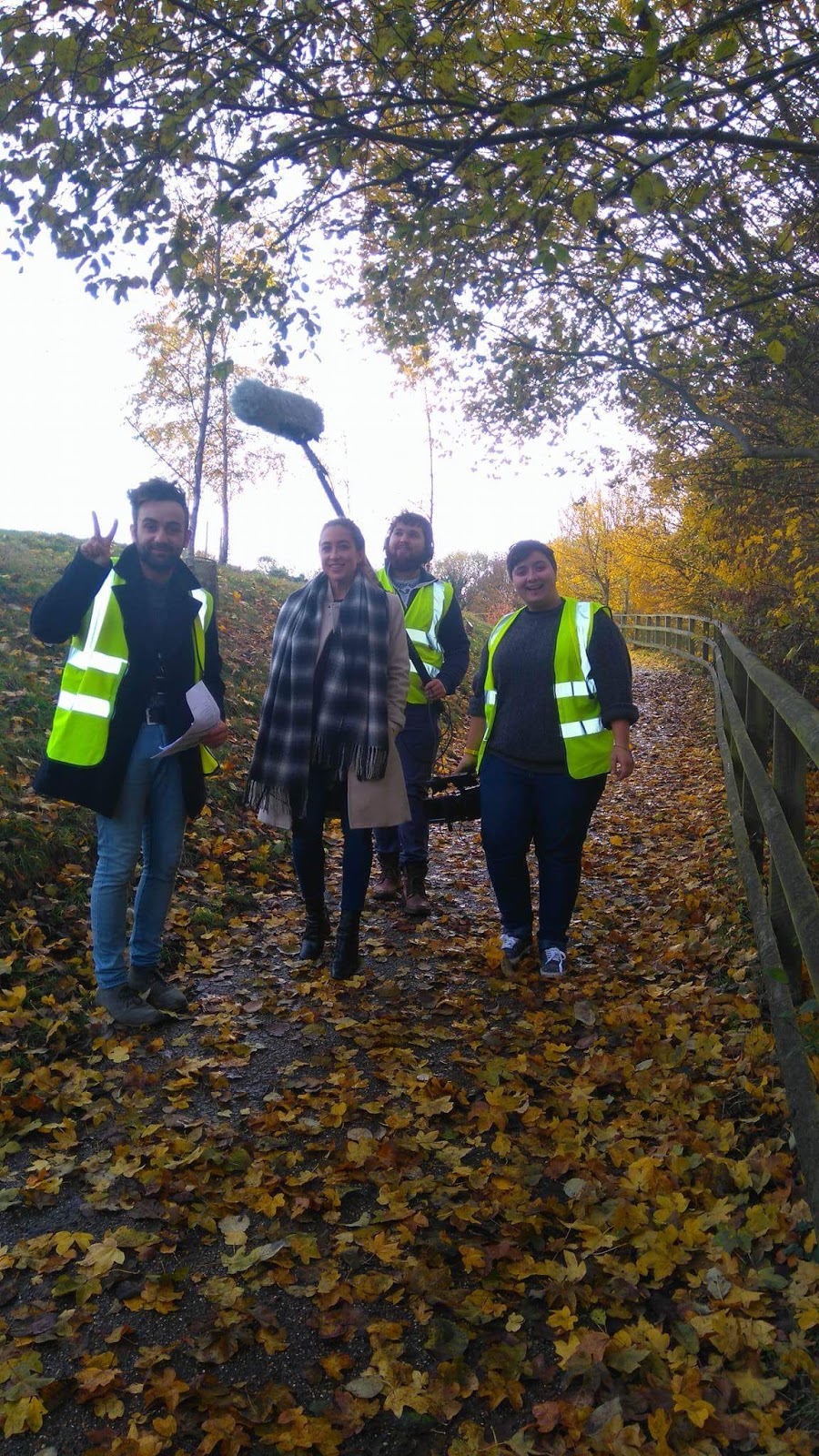
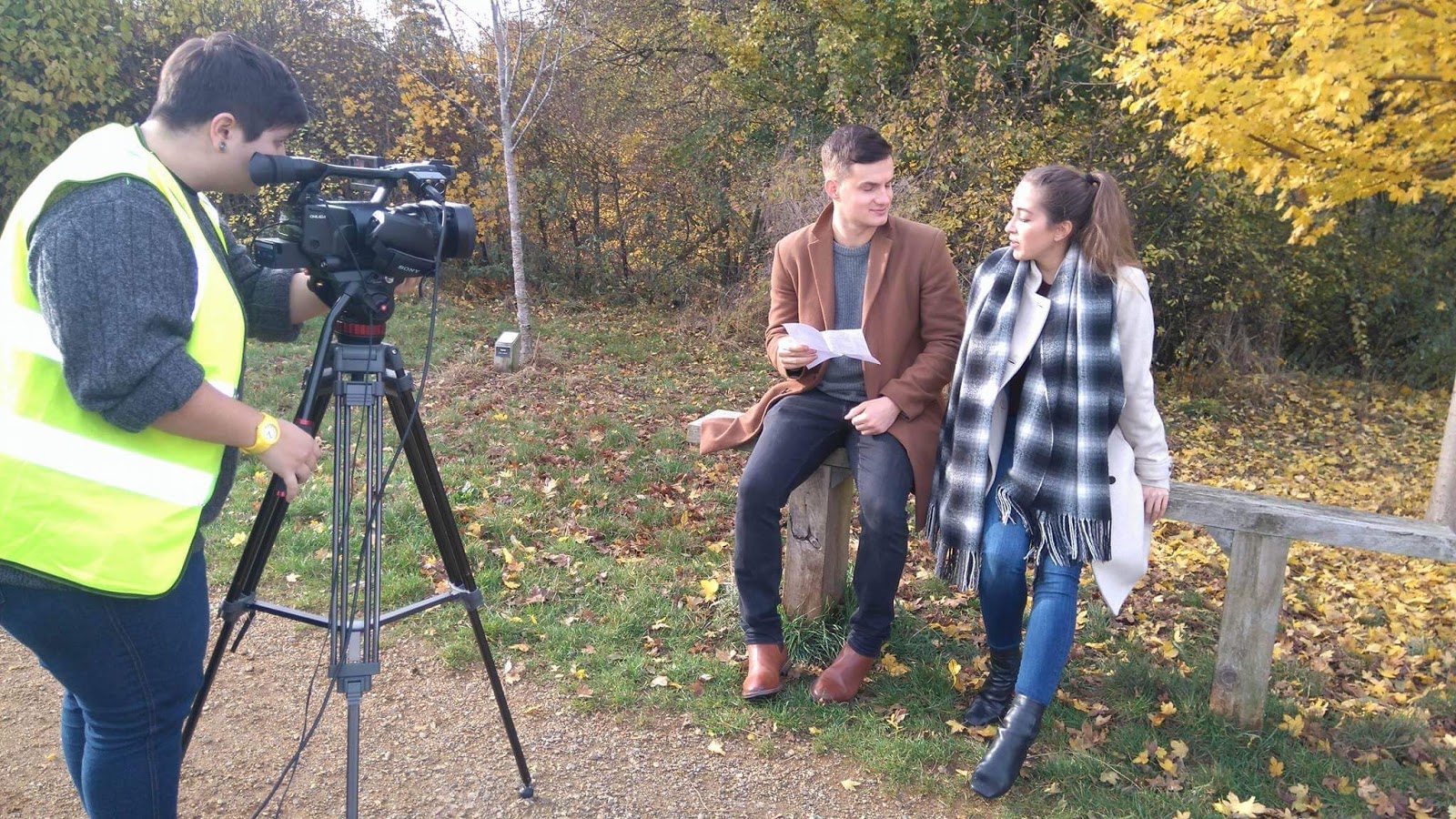
After sending out all the shooting schedules before hand the crew knew what time we were meeting at the studios and I had arranged to pick up the actors at the train station. Once we were all together and signed the equipment out we headed to the first location which was the Bearsted woodland trust. although this is the second scene I decided we would shoot this first due to the lighting conditions. The shoot went successfully as we finished ahead of schedule and all the team were professional.


In some points we had trouble with the wind which affected the audio but it eventually died down and we were able to shoot scenes fine. There was another problem I hadn't foreseen with the bench I was going to use being near a main road so we had to choose a different bench to cut down on traffic noise. 

Once this was finished we moved onto the second location at my house to work on the other scenes. This was a lot more time consuming than I thought as there was a lot more involved in the way of many different shots and angles I wanted to get to make sure the coverage was sufficient and the story was told in the right way. Although some scenes took a little bit longer to shoot it still finished in time and worked well with the lighting as we were ahead of schedule from the other location. 


Tuesday, 15 November 2016

Storytelling Unit - Casting Call Pro

Due to the nature of my screenplay I wanted to hire actors to be the characters of my screenplay. I was told I could use friends and family or people from the course but hiring actors would allow my project to be more professional. I used a recommended website called Casting Call Pro which enlists professional actors available to hire.


I created an account and posted an advert explaining that I was a student who needed a male and a female actor to play the parts for my film. As I'm a student I explained that there would be no payment for the role but they would get a copy of the final edited footage once complete. After a week I had 12 men and 12 women apply for the role. After reviewing there previous show reels I have whittled it down to the 2 people I wanted to play the roles.


After sending them my script and explaining what I wanted done they were very happy to accept the terms and play the parts of my characters.


Monday, 14 November 2016

Story Telling Unit - Shoot Preparation (Shot List, Risk Assessment and Schedule)

As I am going to be shooting the first 2 minutes of my screenplay there are many different things that I need to plan in order to make sure everything is organised and the shoot goes smoothly. The first thing I have done is write out a shot list. This allowed me to look at the script and adapt it into what scenes I wanted to shoot and what coverage I needed to obtain. As I have already visited the locations I was able to visualise in my head the types of shots I wanted to do for example Long shot and close up so that it was relevant to what was required. I will be able to follow this list on shoot so that I won't leave anything out. The shot list can be seen below.


The next thing I did was write out a risk assessment for the 2 locations making sure I was taking into consideration the problems that could occur on set in regards to the health and safety of the cast and crew. When looking at the risk assessment for the Bearsted Woodland Trust park I realised there were several issues to consider. An example would be the fact that its outside and being in a park the terrain may not be even. This would be resolved by making sure all cast and crew are notified and they must wear appropriate footwear on set. This prevents the likelihood of a trip or fall. 


When looking at the risk assessment for the house location there were a few other things to consider. In the event of a fire there, the park would not be as hazardous being in an open place. When inside  building it becomes a lot more dangerous so I had to consider fire exits making sure they were kept clear and to have planned exit routes. There is also furniture and objects that could be a trip hazard so keeping things tidy was important and items were not left in an inappropriate manner. 


Once the risk assessments were signed off by the course leader I was given the go ahead to shoot my film in the locations. My next step was to produce a shooting schedule so the cast and crew know whats happening, when its happening and what is expected time wise throughout the day. I made sure I included the date, location, the crews names, roles and there contact details as well as the equipment that will be needed. As we will be shooting outside I wanted to add a weather section so that when I sent them out to the cast and crew they could prepare appropriately. Underneath this was the time and activity throughout the day to follow and make sure we were on track and got the shoot done on time as we were up against losing day light. 


Overall I think I have planned my shoot very well and believe I have what I need in order for things to go smoothly. 

Sunday, 13 November 2016

Storytelling Unit - Viewing and approving Location's

We had a talk with a woman from the Kent Film office about the permissions and requirements that we had to take into consideration when filming in a public place. This was very useful for me as I was able to understand what I needed to organise before requesting a location to be approved.


Since I only need two locations the first would be set in my house so no permissions were required. The second was to be in a park so I took the time to visit a few locations that I thought could work well. My first thought was mote park but when listening to the Kent Film Office talk I was made aware that they require a fee to film there so I decided to think of somewhere different as I could not afford the expense. I visited a place called Manor Park Country Park and took some pictures of where I could ideally shoot the scenes I needed.


Although this was a good location there was a fee for parking and it was a 20 minute drive from the other location.

I then decided to go and take a look at the Bearsted Woodland Trust park and take some photos of this location. I found this to be more ideal as the scenery was better for the shoot as well as it being only a 5 minute drive from the other location and a free carpark.


With Bearsted Woodland Trust being my first choice for location I emailed the Kent Film Office to make them aware that I wanted to film there. Unfortunately I had a reply back saying that the land was privately owned and I would not be allowed to shoot there unless I gained permission from the owners themselves. From this I then found the contact details on their website and emailed them expressing what I wanted to do. After a few emails back and forth with the deputy chairman of the park John Wale I have been given formal permission to film there on Wednesday 16th November.


Thursday, 10 November 2016

Contextual Studies - Sitcom's

When understanding genre, its a type of media that shares common codes and conventions looking at the social, political and historical contexts. Its very identifiable with an audience. For example if a group of people were sitting at home and in the mood for a horror, they could scroll through a streaming service like Netflix and pick a horror program/film from that section. When watching the horror they will be able to identify with the codes and conventions they are used to in a horror like its score, characters (monster/ killer, survivor), Props (Knife), Location (Isolated areas i.e. an old house) and jump scares or gore. This leaves the audience satisfied as they're prepared to experience these conventions.


When looking at the sub-genre of Sitcom, its a situation comedy that only applies to television. It involves characters resolving a comical situation in their lives. When looking at the Technical conventions of sitcoms filmed in a studio they are generally edited as if the audience is watching it live. This links into the canned laughter that is used in the background to make you feel like you are with a studio audience watching it. For example when watching friends there is laughter throughout at the jokes and gasp moments when something is revealed. Location sitcoms follow slightly different conventions. There is no live laugh track and they are edited in post production. They often have a story for each episode rather than a continued story throughout the series like Arrested Development or Parks and Recreation. Most sitcoms have an ideology based around a family i.e. the work family, nuclear family, extended family and co-habitees.


Sitcoms are done in episodes and generally last around 30 minutes. They use comic traps in there narrative to give depth and add to the story. They start as an equilibrium, then a problem is found, the characters go through the problem, the problem is solved, everything returns to normal. Its done like a cycle and obtains this set up in every episode.


There are many different types of sitcoms in a way that comedy can be shown an example would be a parody. This is a mockery of original work as it imitates the subject they are showing. Its similar to a spoof however this usually makes fun of a genre in its entirety like the Scary Movie films. A satire tends to have a lot more serious issues involved but it makes us laugh when it goes wrong and gets worse.

In terms of mise en scene there are classic things that they use. It generally focuses around something central like a sofa or an office desk. The audience identify this as where the characters lives revolve around. In Friends they use a coffee shop sofa where they all meet to discuss there problems and issues they are having. since friends became more evolved it had many more focus points like their apartments and Rachel's work.


There are general Archetypes/ stereotypes in sitcoms:

The Rebel -a character who uses a more harsh sense of comedy and is very sarcastic
The Libertine - someone who is hyper sexual and uses innuendos
The Authority figure - this character tries to control the situations
The fool - a person who is not very self aware and has the reputation of being stupid.

All of these characters can be seen in Modern Family. We have The rebel who is the eldest daughter of the Dunphy's Hayley and also Luke the youngest, the authority figures Claire Dunphy and Jay Pritchett and the fools Phill Dunphy and Gloria Pritchett. We could also say Gloria is the libertine as well although she is not aware of it.