Friday, 5 May 2017

Documentary Unit - Shoot Week (London Tombs)

Today we shot at the London Tombs for our second Item of the documentary. I drove to the o2 arena and then we got the tube to the attraction as we as a group decided before hand that we wanted to get some footage of me on the tube traveling to show the audience we are moving on to a different attraction.


Although Its clear that the audience can see I am heading to London by these shots, I wanted to further enforce London as a city so I asked the group to shoot some G.V.s of the Shard and Tower Bridge. This was done before we got to the attraction as we had got there in plenty of time. We decided to shoot the Shard and Tower Bridge as these were the two main landmarks you could see from where we was standing, which was on London Bridge, Where the actual attraction was housed.


Once we had done these we went to the attraction itself and experienced what it was all about. I wanted to get a clear reaction of how I felt the experience went so we decided that straight after we would set up the DSLR and the clip mic and get a piece to camera of how my fear and adrenaline was throughout the attraction. We framed this tight and close up to show the emotion of how I was feeling as well as blurring out the attraction slightly in the background.


Once we had done this we went into the gift shop where I had set up an Interview with Kirsty Linton, a sales and marketing representative from the attraction. We wanted to do it inside as it gave an overall feel of the attraction being dark and scary and I made sure I incorporated the interview workshop in how to set it up and making sure the eye line was correct. I presented Kirsty with the questions we would be asking her and we paused 10 seconds between each answer allowing Kirsty to gather her thoughts and also to allow us to edit easier. With filming inside it was dark and we did not have any lighting. We decided to set up near a vending machine that gave a good light source so that the footage would be well lit. Once Kirsty had finished we moved the camera around so I could repeat the questions to the camera. 


Once this was done we were able to get some G.V.'s of the attraction from the outside as well as capture a piece to camera of me introducing it. We wanted a variety of content so we shot the introduction at two different angles and filmed the G.V.'s in a different range of shots. 


Overall the shoot went well and I have a lot to work with for when it comes to editing it together. 

Monday, 1 May 2017

Documentary Unit - Shoot Week (Thorpe Park)

After getting a clear schedule and week view of what we were shooting on different days, today we shot at our first shooting location, Thorpe Park. We arrived at the park on schedule before it opened at 10:00am to give us plenty of time to queue and get into the park. Once in, we had the whole day to shoot the pieces we needed.

 We were not allowed to use a tripod as it was a public place where guests were responsible by the park so we used a Canon DSLR and a Clip Mic to capture throughout the day. I wanted to make sure we got all the footage we needed as this was going to be a main feature of the documentary so we made it our priority to shoot all of the presenting bits first then get GV's of all the rides and attractions to get an overview of the park.

I first introduced where I was and what I was doing at the park. We decided that the best place to do this was on a public balcony giving an overview of the entire park. This gave an establishing shot to the audience and allowed them to see what I was talking about.


Once we had done this we moved onto the first ride of the day, 'Stealth'. We decided using the stealth plaza would be a great place to introduce the ride and explain a bit about what it entails. We shot a piece to camera of myself using a clip mic to minimise other sounds with the ride in the background and purposely timed the piece so it would get the ride passing upwards as I started to speak and then pass back down again as I finished. This added a real impact to what I was talking about and gave the audience something to look at. 


After this we moved onto 'Derren Browns Ghost Train' and shot a piece to camera in the exact same way outside the attraction and its gates. As the other one was a shot of me walking from quiet a distance towards the camera we felt we needed a bit of variety. We decided to frame this shot tighter as a mid shot but stood me to the left to allow the audience to see I was still outside the attraction.

Stealth Framing


Ghost Train Framing


Once we had done pieces the two main pieces to camera I then experienced the rides for myself and gave the crew then filmed a review at the end to explain how my level of fear and adrenaline was throughout the 2 different attractions.

 We then focused on G.V.s. This involved various shots and sequences around the park of the rides and of me walking to allow for cut aways and voice overs. We also wanted to make sure we got a shot of the entrance sign to further establish where I was.


After this it was time to go home upload the footage to my laptop. We synced the screen to my television and viewed what we had done and how the shots looked on the bigger screen. Overall I am very happy with the coverage we have got and what we managed to achieve on the shoot.


Sunday, 30 April 2017

Documentary Unit - Shot List

Here are a the shotlists that we used for the shoot.


Saturday, 29 April 2017

Directions Unit - Editing Research

As I am going to be the main editor for the project I wanted to look into some research to help strengthen my skills. I wanted to learn about adjusting sound as this is one of the things I feel I'm weak at when editing.  I found a great page on Lynda.com at this link: https://www.lynda.com/Audition-tutorials/Welcome/176757/482954-4.html that helped me to understand some basic things to help me.


I learnt some really interesting points that will come useful for when I edit. This includes how to sync  offline devices, syncing sound together and a few basic effects you can overlay to make it flow better.

I also looked at the help site for adobe that can be found on the link here: https://helpx.adobe.com/uk/premiere-pro/how-to/edit-videos.html . This allowed me to expand my editing skills looking at keyboard shortcuts, turning the FX on and off and using Lumetri scopes to the best of their advantage.

I know the documentary is going to involve a lot of cut aways with many GV's being used so I wanted to make sure my knowledge of editing these would be up to scratch. I watched this video on youtube that can be viewed below that really helped me understand cut aways in depth.


This video gave me an understanding of how cut aways work and where they are best positioned in order to help the video flow. I have learnt a lot from this and will put it into practice when it comes to editing the documentary. 


Friday, 28 April 2017

Documentary Unit - Researching Fear

After we knew what we wanted to do, I have been looking into some research as to why we face our fears. We sat down as a group earlier and watched a few TED talk's (an education based website/ app displaying videos in the style of YouTube, particularly focusing on a lecturer explaining a topic) about fear but one in particular was by a woman named Michelle Poler. She talks about how when she was at uni she was set a task to do over a 100 days and decided to do hers based on carrying out one of her fears each day. She explained how she felt and why she wanted to do this journey as well as some facts about why people are so scared of things we don't need to be afraid of.


I have also been looking into so facts and figures of fear in general. Here is a document we compiled together for the documentary.


Wednesday, 26 April 2017

Documentary Unit - Locations

As the documentary is all about fear we needed to think carefully about where we can go and what would work well. I did some research and created a spider diagram of the posabilities and what they would be needed for based on the structure we had previously talked about.


Our group went over the ideas and decided for the themepark we should go to Thorpe Park as it has got the reputation as the nations 'Thrill Capital' and is the closest atraction of that type to where we are based. We thought about using the rollercoaster 'Stealth' as its the fastest and one of the tallest in the U.K. going 0 - 80mph in 2 seconds. The second location would be 'Derren Browns Ghost Train' as its a dark ride attraction and is their most recent investment playing on the audiences perception of reality using fear. 

Stealth


Derren Browns Ghost Train


For a scare attraction we first thought about an escape room as these types of attractions are becoming very popular and can vary on experience. When looking at the one based in Chatham, there was a horror based one named 'Body Parts' which would prove to be the type of attraction we are looking for. After some consideration we decided that we needed something abit more recognisable and is more dedicated to the scare element than the escape game. We thought the 'London Tombs' would be a great place to do this. Its been voted the best scare attraction in the UK and has won an award for scariest attraction in the world so this we thought fitted the brief perfectly. 


With the Skydive we knew that this was going to be an important one to get right. We needed to find a repturable company that had insurance, all the right qualifications and would allow filming of the jump itself. We first looked at 'Headcorn Airfield' as this was not far from where we are based but it proved to be very expensive and had no places for the date we was looking for. The next location we looked at was 'The North London Skydiving Center' in Chateris. This proved to be a lot cheaper and have a certificated granted by the 'British Paracute Association'. They also offered filming services and had some spaces for the day we wanted to do it on. 


For the presenter introductions and some reviews of the day we all thought it should be personal and  very much about the presenter. We decided that since I was presenting, it would be great to do these outside/ inside my house. It gives the audience a sense about my life in terms of where I live and allows them to connect more with me. This is also where we have decided to hold Jackies interview as it shows her coming to my house to talk to me about her experiences making it personal and relatable. 


Tuesday, 25 April 2017

Documentary Unit - Presenter Research

As I am going to be a presenter I wanted to do some research so that when it came to it, I could look as natural as possible. I was looking on a national career service website that explained the key skills to presenting:


From this I have taken it into account and I will practice learning scripts and keeping calm under pressure when the camera records, especially pieces to camera.

I also watched a video on youtube that helped me to understand how to make my presenting seem more established by anchoring myself, trying to keep my eyes on the lense for as much as possible and talking as if I'm reaching one person. The video can be viewed below.


The other video I looked at taught me to introduce myself and really let my personallity shine through. I need to seem human to viewers and not robotic or static. 


I have learnt alot from the videos and tips from websites that I will take on board when it comes to presenting the documentary. 


Documentary Unit - Fear Pitch Document & Presenter Casting

After brainstorming and coming up with ideas for the new documentary, we have come up with a pitch document to help us understand and organise what we are proposing to do. It contains a synopsis, why we are doing this story, characters and the treatment.


We were thinking about presenters and decided to pick a member of our group to lead the documentary. We thought this was best due to time, money and with them being comfortable doing the extreme activities. After a long discussion we decided that I would present to the camera. I have created vlogs in the past and feel comfortable in front of the camera. The group also said my personality would be good for the documentary and that I come across likeable allowing the audience to align with me. I feel happy doing this for the group and taking on the extra work of presenting as well as being part of production.


Monday, 24 April 2017

Documentary Unit - Our New Idea

Over the easter holidays I have been trying to research bootcamps and liaise with different companies as well as find a presenter for the group. I was not having a lot of luck as people were to busy or would not allow us access for the cameras. After talking to the group I told them that some people would give us an interview but not on camera and we all decided that visuals would be key for the documentary to work.

After a hard decision I proposed to scrap this idea all together as the means of communication was proving difficult and we were all stressed with the uphill struggle. I told the group about a new Idea I have been thinking about incase we decided to change and the group felt it was stable, interesting and would create a more appealing documentary for the teen market.

The idea is all based around fear with many proposed questions. Why do we have it? Why do we still experience it? But mainly, why do we still seek it out? We discussed these questions as a group and thought the best way we can make this documentary exciting and interesting as well as informative would be to have a presenter that the audience could align with and put them through fear based activities to see how they responded in terms of their levels of anticipation, experience and adrenaline. We wanted to prove that there is a reason why people do it and why we feel the need to do it but also give the audience good visuals and take them on a journey with the presenter.

After we looked at this idea we decided to think about what activities we could do and how far we would push our presenter into feeling fear. We thought of a theme park with rollercoasters, a horror based attracting with live interactivity, a screening of what is thought to be a really scary film and a phobia of the presenters. We then had a further thought in thinking, what is one of the scariest and most adrenaline fuelled thing a person can do. A member of the group suggested that she thought Sky diving and we all agreed so we are thinking to incorporate this into the documentary and ideally would love our presenter to do one.


Sunday, 9 April 2017

Documentary Unit - Researching A Documentary Series (Stacey Dooley Investigates)

As the Brief for this unit was BBC Three, I wanted to look at a documentary series that was commissioned by the same company. I decided that I wanted to review the Stacey Dooley Investigates series as it touched on issues around the world but from a presenters journey. The series focuses on 3 different episodes with 3 different issues. The 1st is about young sex for sale in Japan, the 2nd about the disappearance and murders of Canadian women and the last is about mums selling their children to the sex industry.

In terms of narrative structure, each of the episodes start of with an introduction to what is going to be talked about, followed by an introduction of the presenter. I feel this works really well and like the structure this gives to the opening. You instantly know a bit about the person who's presenting to you as well as whats to come. I would strongly recommend to the group about bringing this to our own documentary as I feel its effective and sets it up nicely. Stacey then goes on to say what she's going to look at first followed by her carrying this out and following her as she does each item. Giving her opinion on how she feels through each of the activities, it really adds to the story as she becomes relatable and becomes a talking point for the audience as well as the subjects raised. She rounds each episode off with what she has looked at and then her final opinion. I like the structure as it flows well and creates an interesting view on what we as an audience are watching. Also helping it to run seamlessly are the addition of characters that appear all the way through and re appear more than once. I would like to try this with our own documentary.

When looking at the conventions there are many that help us to see its a documentary. There are facts and figures that appear on screen, vox pops, shakey handheld camera movements, pieces to camera, GV's and cut aways. These are visible throughout the whole documentary series and really heightens the sense of realism and the overall reality of it all. The GV's and cutaways always relate to what she is talking about helping the audience to visualise in terms of location and situation. There are also many sequences of the presenter when she's not doing a piece to camera with the addition of sequences. I want to encorporate lots of GVs that help to tell the story and establish its location and to give a real sense of the situation our presenter is in. It is done a lot through the series and is key throughout so I want to bring this to our work.

GV


Sequence


When listening to the music it changes depending on the emotion that is trying to be conveyed. In the Canadas Lost Girls it varies from intense when there is a moment of mystery or when something sinister is being talked about, to emotional and sad when it talks about the girls and the lost it has brought to their families who haven't had any justice into why or who murdered them. I want to use music as affective as this documentary uses it aligning the emotion with the visual to tell the audience how I want them to feel.

Overall I found this series informative and interesting using many of the documentary conventions but focusing on the presenter and how she feels throughout embarking on a journey through different stories. I want to make sure our documentary does this and conveys the right emotions to the story we are trying to tell.

Saturday, 8 April 2017

Documentary Unit - Researching A Documentary Film Maker (Louis Theroux)

Louis Theroux is a documentary filmmaker that was born in Singapore and moved to England as a young child. At the start of his career he became a journalist over in America before appearing regularly on the at TV show by Michael Moor called TV Nation. It was from here that his TV appearances became more regular and Theroux started making documentaries in the late 90's. His first main documentary was called When Louis Met Jimmy as it looks how to capture the famous TV personality behind his chaotic life in 2000. From here on Louis has won two BAFTA awards and has continued to make documentaries ever since.

The reason I am looking at Theroux is because his documentaries are very presenter heavy and shows his involvement in activities. As a group we all decided that this is something we all wanted to do and show a presenter being followed on their own personal journey as it feels more interesting than just facts and figures. Its also the style he incorporates into his documentaries that I find interesting and could help with our structure.


Main Directing Credits:

Louis Theroux's Weird Weekends (2000)


When Louis Met (2001)


Louis Theroux: A Place For Paedophiles (2009)


Louis Theroux's LA Stories (2014)


Louis Theroux: Savile (2016)


Directing Style And Trademarks:
Theroux often creates documentary on controversial topics. From the credit list you can see that he talks about Paedophiles including the more recent Jimmy Savile documentary in 2016. I watched this and felt it was interesting as although its about pushing boundaries, its not heavily based around statistics. It focuses on Theroux's relationship with Savile over the years and his own opinion on him so this is the sort of feel I want to add to the documentary. I also watched the episode from Louis Theroux's Weird Weekends that focuses on the Demolition Derby. This I found very interesting as although it talks a lot about the Derby itself, he also experiences it making him a participant in the activity. I want to make sure our presenter participates in an activity for the documentary as it feels interesting and it works well.

Another trademark of Louis' is getting involved and personal with real people. He interviews them but he builds a relationship with the person he's talking to. I want to make sure when the presenter is having a conversation with someone in our documentary they look comfortable rather than just interviewing them.

After looking at Louis Theroux and his work I feel I have researched him well and can take elements of style for our own documentary.


Monday, 3 April 2017

Documentary Unit - Producing a Script

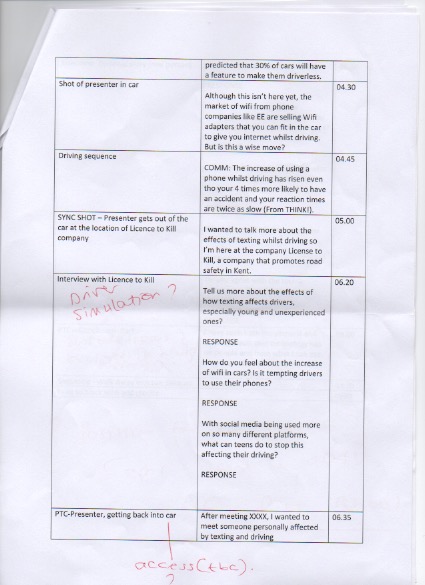
Over the past couple of days me and Jemma sat down and wrote a script for the documentary. It is laid out in the correct format with the visual elements on the left and audio on the right. We also added time codes on the end as we wanted to get a rough estimate of how long the documentary would last and see if any cuts were needed to be made. We used shortened terminology like PTC (piece to camera) and GV (general View) so that the script was not cluttered and made it easy to read.

After showing the script to Helen she gave us a lot of good feedback on how to improve our script and the overall structure of the documentary. She explained that there was not enough focus on one particular thing and it was too heavy in terms of different content being incorporated. With this in mind we decided to focus just on the digital detox bootcamp and cut the other ideas we had including a dangerous driving and financial sections. She also explained that it was not personal enough and we needed to chat to our audience rather than talk at them.

The other thing said was that It was very one way and there was not enough positives to look for example a segment can talk about how apps have helped people in education, stress and money.


All this feedback had been taken on board and our group will re draft the script accordingly.